Thermal and Electrical Properties of Zinc-Strontium-Lithium Phosphate Glass Doped with Carboxymethyl Cellulose

Authors

  • Siti Norfariza Farhana Mohd Razak Advanced Optical Materials Research Group, Faculty of Science, Universiti Teknologi Malaysia, Johor, Skudai, 81310, Malaysia
  • Farhana Mohamiddin Advanced Optical Materials Research Group, Faculty of Science, Universiti Teknologi Malaysia, Johor, Skudai, 81310, Malaysia
  • Nurhafizah Hasim Advanced Optical Materials Research Group, Faculty of Science, Universiti Teknologi Malaysia, Johor, Skudai, 81310, Malaysia
  • Nur Hidayah Ahmad Advanced Optical Materials Research Group, Faculty of Science, Universiti Teknologi Malaysia, Johor, Skudai, 81310, Malaysia
  • Norshahirah Mohamad Saidi Advanced Optical Materials Research Group, Faculty of Science, Universiti Teknologi Malaysia, Johor, Skudai, 81310, Malaysia
  • Mohd Fuad Mohamad Department of Chemistry, Faculty of Science, Universiti Teknologi Malaysia, Johor, Skudai, 81310, Malaysia
  • Anis Nazihah Mat Daud Department of Physics, Faculty of Science and Mathematics, Universiti Pendidikan Sultan Idris, 35900 Tanjung Malim, Perak, Malaysia

Keywords:

Phosphate glass, DTA, EIS

Abstract

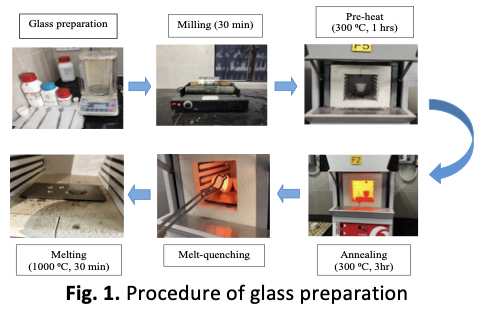
The influence of Carboxymethyl Cellulose (CMC) on the thermal and electrical properties of phosphate glass has attracted considerable attention, yet its mechanistic role in modifying glass structure remains insufficiently understood. This study aims to synthesize and characterize phosphate glasses with composition (40−x)P₂O₅–30ZnO–25Li₂O–5SrO–(x)CH₂COOH (0.0 ≤ x ≤ 0.5 mol%) to elucidate how CMC incorporation reshapes the glass network and alters its physical, thermal, and electrical behavior. The glasses were prepared by melt-quenching and characterized using XRD, DTA, and EIS analyses. Density increased from 2.604 to 3.194 g/cm³ and molar volume decreased to 29.326 cm³·mol⁻¹ at 0.2 mol% CMC, indicating stronger network compaction. The optimal composition at 0.2 mol% CMC exhibited the highest ionic conductivity (2.89 ×10⁻⁷ S·cm⁻¹) and lowest activation energy (1.20×10⁻² eV). This enhancement arises from CMC’s carboxylate groups, which form hydrogen-bonded linkages with phosphate tetrahedra and stabilize Li⁺ pathways within the matrix. The findings demonstrate that low-level CMC addition effectively tunes network rigidity, ionic mobility, and dielectric response, providing a green and sustainable strategyfor tailoring the performance of phosphate-based functional glasses.

👁 Abstract Views: 18📥 PDF Downloads: 22

Downloads

Published

2026-10-20

How to Cite

Siti Norfariza Farhana Mohd Razak, Farhana Mohamiddin, Nurhafizah Hasim, Nur Hidayah Ahmad, Norshahirah Mohamad Saidi, Mohd Fuad Mohamad, and Anis Nazihah Mat Daud. 2026. “Thermal and Electrical Properties of Zinc-Strontium-Lithium Phosphate Glass Doped With Carboxymethyl Cellulose”. Semarak International Journal of Electronic System Engineering 7 (1):22-32. https://sijese.com/index.php/journal/article/view/24.

Issue

Section

Articles