Generation of a Q-Switched Erbium-Doped Fiber Laser using MXene V₂CTx as Saturable Absorber

Authors

  • Nurul Athirah Mohamad Abdul Ghafar Department of Electrical Engineering, Faculty of Engineering, Universiti Malaya, Kuala Lumpur, Malaysia
  • arnimunira@uitm.edu.my School of Electrical Engineering, College of Engineering, Universiti TeknologiMARA, 40450 Shah Alam, Selangor, Malaysia
  • Nur Farhanah Zulkipli Department of Engineering and Built Environment, Tunku Abdul Rahman University College (TARUC) Penang Branch Campus, 11200 Tanjong Bungah, Pulau Pinang, Malaysia
  • Retna Apsari Department of Physics, Faculty of Science and Technology, Universitas Airlangga, Jl.Mulyorejo, Surabaya 60115, Indonesia
  • Sulaiman Wadi Harun Department of Electrical Engineering, Faculty of Engineering, Universiti Malaya, Kuala Lumpur, Malaysia

Keywords:

Q-switching, MXene, saturable absorber, Erbium-doped fiber laser

Abstract

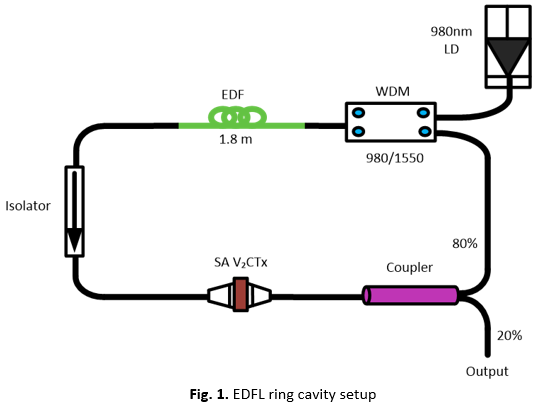
Fiber laser generation is widely studied for applications in telecommunications and industrial processes, yet enhancing laser performance, especially with effective saturable absorbers (SAs), remains a challenge. This research focuses on using MXene V₂CTx film as a saturable absorber to generate Q-switched fiber lasers. A passive fiber laser was developed using a solution casting method to fabricate the MXene V₂CTx SA. When pump power was increased from 50.66 to 149.79 mW, stable Q-switched pulses at 1530 nm were achieved, with a maximum repetition rate of 93.41 kHz, a pulse width of 3.24 μs, and a pulse energy of 48.82 nJ. These findings demonstrate that MXene V₂CTx is effective in producing stable Q-switched fiber lasers, offering potential for enhanced laser performance in various applications.

👁 Abstract Views: 32📥 PDF Downloads: 43

Downloads

Published

2026-10-20

How to Cite

Nurul Athirah Mohamad Abdul Ghafar, arnimunira@uitm.edu.my, Nur Farhanah Zulkipli, Retna Apsari, and Sulaiman Wadi Harun. 2026. “Generation of a Q-Switched Erbium-Doped Fiber Laser Using MXene V₂CTx As Saturable Absorber”. Semarak International Journal of Electronic System Engineering 5 (1):1-7. https://sijese.com/index.php/journal/article/view/25.

Issue

Section

Articles