Modelling A Finite Element Analysis for Pull-In Voltage of RF MEMS Switch using Comsol Multiphysics
Keywords:
Comsol multiphysics, finite element analysis, microelectromechanical system, polysilicon, pull-in voltage, RF MEMS switch, snaps-inAbstract
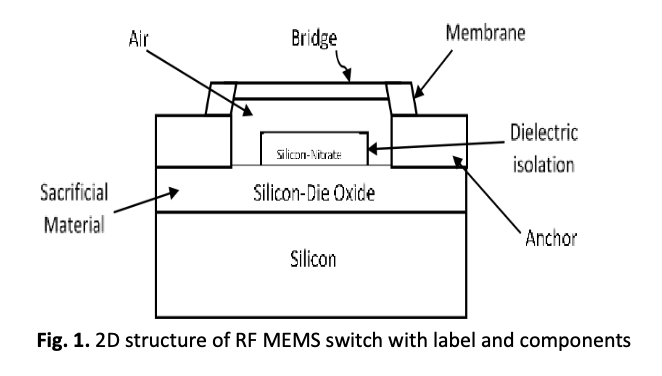
Microelectromechanical systems integrate electrical and mechanical components such as actuators, sensors, and electronic structures on silicon substrates and have feature sizes ranging from micrometres to millimetres. Fabrication of MEMS devices requires appropriate MEMS fabrication technologies to realize its small geometries with precise dimensional control. Strict fabrication process control is required to obtain repeatability of the manufactured product for the required design. Therefore, the development of standards for testing to minimize fabrication and testing failure, especially in obtaining the ideal standard switch, has always been of major concern for the design of RF MEMS switches. The conventional semiconductor switch, such as positive intrinsic negative diodes and field-effect transistors, has low efficiency due to low isolation, high insertion losses, and low linearity response. These are the push factor to research more in-depth on the capability of the new RF MEMS switch. This study focused on the modelling and finite element analysis of an RF MEMS switch using Comsol Multiphysics software. The simulation was conducted based on the range of pull-in voltage retrieved from the literature review which is from 4.5 V until 5.5 V. The actual result obtained from the conducted simulation shows that the pull-in voltage value for application usage is 5.0 V, while the value for tested pull-in voltage injected is 3.5 V. The value difference is due to the high vibration and pressure occurs in actual switch application. The study's objective is to determine the initial switch voltage required before switching to the ON state since it is a capacitive switch. The tested initial voltage is 0.7 mV, 1 mV, and 3 mV with pull-in voltage is set at 5.0 V. 1 mV is selected as the optimum initial voltage since it provides reliable value resulting from displacement while at the same time not exceeding the ON state rate. The polysilicon cantilever of the RF MEMS switch is designed and simulated to study the displacement and capacitance due to electrostatic force from the injected maximum voltages from applied 1 V to 9 V. At 3.5 V applied tested pull-in voltage, RF MEMS switch enters ON state with the maximum displacement obtained is 0.9 μm at the rate of 39 μs, while the capacitance is 6.8 pF and contact force is 7.76 x 10⁻⁴ N/m2. When the maximum voltage is further increased to 7.5 V until 9 V, the displacement and capacitance are maintained at 0.9 μm and 6.8 pF, respectively but with the snaps-in issue. The highest contact force is shown by red colour based on the colour intensity scale observed in the simulation result regarding the snaps-in issue. Abstract Views: 15 PDF Downloads: 10
Downloads
Published
2026-11-14
How to Cite
Mohamad Zulkifly Ikmal Abdullah, Siti Nooraya Mohd Tawil, Burhanuddin Yeop Majlis, Jumril Yunas, Azrul Azlan Hamzah, and Kamarul ‘Asyikin Mustafa. 2026. “Modelling A Finite Element Analysis for Pull-In Voltage of RF MEMS Switch Using Comsol Multiphysics ”. Semarak International Journal of Electronic System Engineering 12 (1):11-31. https://sijese.com/index.php/journal/article/view/49.
Issue
Section
Articles